Narcissistic Personality Disorder - Miscellaneous Issues
Frequently Asked Questions # 7-9
I. In what type of narcissist is it worthwhile to invest emotionally?
II. What is the reaction of a narcissist likely to be when confronted with your texts or book?
III. how can one tell whether one is interacting with the IMAGE, or with the REAL PERSON?
Narcissism, Pathological Narcissism, The Narcissistic Personality Disorder (NPD), the Narcissist,
and Relationships with Abusive Narcissists and Psychopaths
In what type of narcissist is it worthwhile to invest emotionally?
Answer:
This, obviously, is a matter of value judgement. Narcissism is a powerful force, akin to the psychological element in drug addiction. The narcissist is sustained by ever increasing amounts of Narcissistic Supply. Adoration, approval, attention and the maintenance of an audience – are the nourishment without which the narcissist shrivels.
Depending on how talented the narcissist is, Narcissistic Supply could be the by-product of real achievements. The narcissist usually applies his skills and exploits his natural advantages where they provide him with the highest narcissistic rewards. For instance: he writes books to gain public acclaim – not because he has something to say or because he cannot contain his emotions or his message. Still, narcissists are, mostly, gifted and, therefore, are able to contribute to society at large. They become artists, authors, political leaders, business leaders, or entertainers – in order to bask in the limelight.
Some narcissists could be judged "worthy of sacrifice". They benefit their community "more" than they harm it. Those nearest and dearest pay a price – which is deemed more than amply compensated for by the contributions of the narcissist to the well-being of his community.
What is the reaction of a narcissist likely to be when confronted with your texts or book?
Answer:
It takes a major life crisis to force the narcissist to face up to his False Self: a painful breakdown of a close (symbiotic) relationship, a failure (in business, in a career, in the pursuit of a goal), the death of a parent, imprisonment, or a disease.
Under normal circumstances, the narcissist denies that he is one (denial defence mechanism) and reacts with rage to any hint at being so diagnosed. The narcissist employs a host of intricate and interwoven defence mechanisms: intellectualisation, projection, projective identification, splitting, repression and denial (to name but a few) – to sweep his narcissism under the psychological rug.
When at risk of getting in touch with the reality of his mental disorder (and, as a result, with his emotions) – the narcissist displays the whole spectrum of reactions usually associated with bereavement. At first he denies the facts, ignores them and distorts them to fit an alternative, coherent, "healthy", interpretation.
Then, he becomes enraged. Wrathful, he attacks the people and social institutions that are the constant reminders of his true state. Then he sinks into depression and sadness. This phase is, really, a transformation of the aggression that he harbours into self-destructive impulses.
Horrified by the potential consequences of being aggressive towards the sources of his Narcissistic Supply – the narcissist resorts to self-attack, or self-annihilation. Yet, if the evidence is hard and still coming, the narcissist accepts himself as such and tries to make the best of it (in other words, to use his very narcissism to obtain Narcissistic Supply).
The narcissist is a survivor and (while rigid in most parts of his personality) very inventive and flexible when it comes to securing Narcissistic Supply. The narcissist could, for instance, channel this force (of narcissism) positively – or defiantly caricature the main aspects of narcissism so as to attract attention (albeit negative).
But in most cases, the reflexes of avoidance prevail. The narcissist feels disenchanted with the person or persons who presented him with proof of his narcissism. He swiftly and cruelly parts ways with them, often without as much as an explanation (he does the same when he envies someone).
He then proceeds to develop paranoid theories to explain why people, events, institutions and circumstances tend to confront him with his narcissism and he, bitterly and cynically, opposes or avoids them. As anti-narcissistic agents they constitute a threat to the very coherence and continuity of his personality and this probably serves to explain the ferocity, malice, obduracy, consistency and exaggeration which characterise his reactions. Faced with the potential collapse or dysfunctioning of his False Self – the narcissist also faces the terrible consequences of being left alone and defenceless with his sadistic, maligned, self-destructive Superego.
When interacting with a narcissist, how can one tell, at any given moment, whether one is interacting with the IMAGE, or with the REAL PERSON? Or is it ALWAYS the image that is to the fore, and NEVER the real person?
Answer:
The short and the long of it is that one always interacts with the False Self (=the Image, in your question) and not with the True Self or (luckily) with the Superego (=the "real man", to use your coinage).
The latter emerge and become observable and discernible only in times of severe stress induced by life crises. The maintenance of the False Self is so demanding and takes up so much energy that it crumbles when that energy is used up by another situation.
A much more detailed analysis of these psychodynamics can be found in this essay: "Malignant Self Love - Narcissism Revisited".
Also Read These Articles
The Professions of the Narcissist
Narcissists, Disagreements and Criticism
The Dual Role of the False Self
Watch: Related Videos by Prof. Vaknin
Ranked by relevance to this article — start with #1, scroll right for more
-
1

Can You Diagnose Your Narcissist?
-
2

NPD Narcissist, or Merely Narcissistic Style? Sick, or Just A-hole? (Narcissistic Style)
-
3
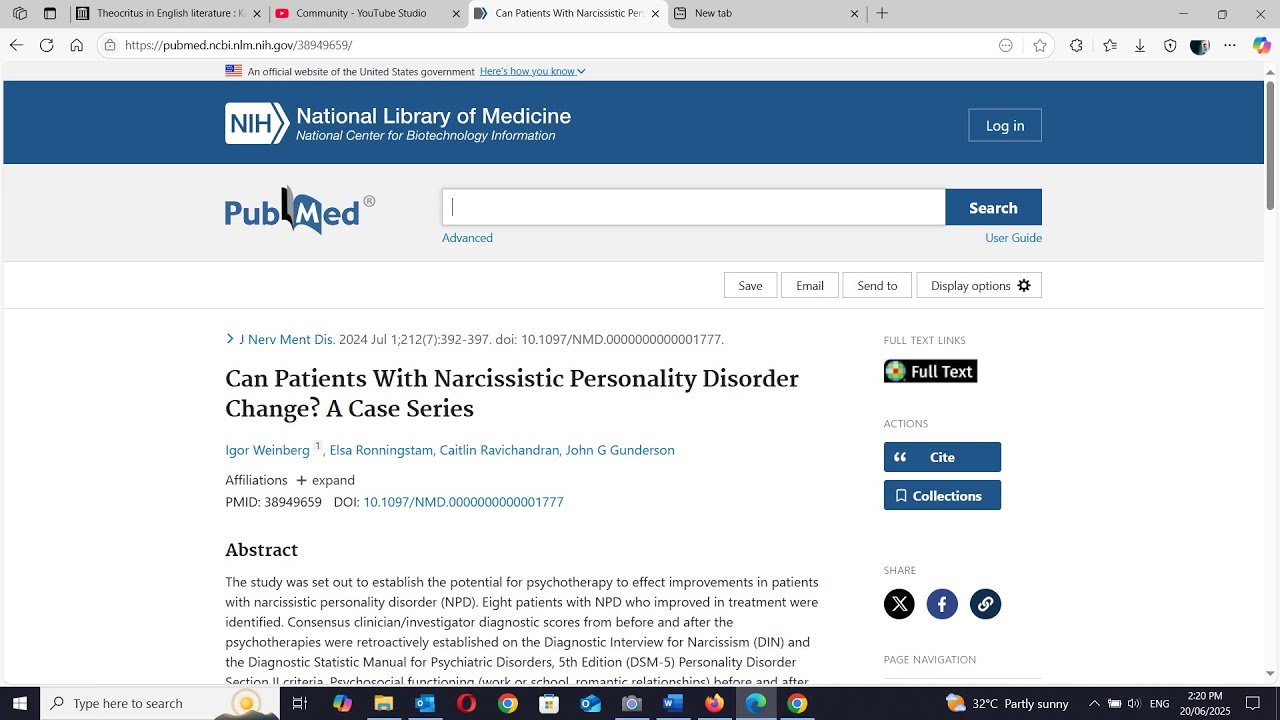
NEW STUDY: NPD Cured? NOT!
-
4

Abolish Narcissistic Personality Disorder (NPD) in DSM V?
-
5

Narcissistic Personality Disorder Clinical Features
-
6

Mega TV's Idea Lab: NARCISSISM (My responses in ENGLISH) - Part 2/2
-
7

Resist Narcissism, Grassroots Up! (Interview with Dr. Lisa Alastuey)
-
8
DSM V Alternative Model for Narcissistic Personality Disorder (NPD)