Misdiagnosing Narcissism: Generalised Anxiety Disorder (GAD)
Click HERE to view the video
“At the turn of the millennium, as the nation stood atop an unprecedented summit of peace and prosperity, anxiety surged past depression as the most prominent mental health issue in the United States. America now ranks as the most anxious nation on the planet, with more than 18 percent of adults suffering from a full-blown anxiety disorder in any given year, according to the National Institute of Mental Health. (On the other hand, in Mexico—a place where one assumes there's plenty to fret about—only 6.6 percent of adults have ever met the criteria for significant anxiety issues.)
Stress related ailments cost the United States an estimated $300 billion per year in medical bills and lost productivity, and our usage of sedative drugs has shot off the charts: between 1997 and 2004, Americans more than doubled their yearly spending on antianxiety medications like Xanax and Valium, from $900 million to $2.1 billion. And as the psychologist and anxiety specialist Robert Leahy has pointed out, the seeds of modern worry get planted early. 'The average high school kid today has the same level of anxiety as the average psychiatric patient in the early 1950s,' he writes. Security and modernity haven't brought us calm; they've somehow put us out of touch with how to handle our fears.”
(Nerve: Poise Under Pressure, Serenity Under Stress, and the Brave New Science of Fear and Cool by Taylor Clark, Little, Brown, 2011, pp. 245-248)
(The use of gender pronouns in this article reflects the clinical facts: most diagnosed narcissists are men, though women seem to have caught up recently.)
Anxiety Disorders – and especially Generalised Anxiety Disorder (GAD) – are often misdiagnosed as Narcissistic Personality Disorder (NPD).
Anxiety is uncontrollable and excessive apprehension. Anxiety disorders usually come replete with obsessive thoughts, compulsive and ritualistic acts, restlessness, fatigue, irritability, difficulty concentrating, and somatic manifestations (such as an increased heart rate, sweating, or, in Panic Attacks, chest pains).
By definition, narcissists are anxious for social approval or attention (Narcissistic Supply). The narcissist cannot control this need and the attendant anxiety because he requires external feedback to regulate his labile sense of self-worth. This dependence makes most narcissists irritable. They fly into rages and have a very low threshold of frustration.
Like patients who suffer from Panic Attacks and Social Phobia (another anxiety disorder), narcissists are terrified of being embarrassed or criticised in public. Consequently, most narcissists fail to function well in various settings (social, occupational, romantic, etc.).
Many narcissists develop obsessions and compulsions. Like sufferers of GAD, narcissists are perfectionists and preoccupied with the quality of their performance and the level of their competence. As the Diagnostic and Statistical Manual (DSM-IV-TR, p. 473) puts it, GAD patients (especially children):
"… (A)re typically overzealous in seeking approval and require excessive reassurance about their performance and their other worries."
This could apply equally well to narcissists. Both classes of patients are paralysed by the fear of being judged as imperfect or lacking. Narcissists as well as patients with anxiety disorders constantly fail to measure up to an inner, harsh, and sadistic critic and a grandiose, inflated self-image.
The narcissistic solution is to avoid comparison and competition altogether and to demand special treatment. The narcissist's sense of entitlement is incommensurate with the narcissist's true accomplishments. He withdraws from the rat race because he does not deem his opponents, colleagues, or peers worthy of his efforts.
As opposed to narcissists, patients with Anxiety Disorders are invested in their work and their profession. To be exact, they are over-invested. Their preoccupation with perfection is counter-productive and, ironically, renders them underachievers.
It is easy to mistake the presenting symptoms of certain anxiety disorders with pathological narcissism. Both types of patients are worried about social approbation and seek it actively. Both present a haughty or impervious facade to the world. Both are dysfunctional and weighed down by a history of personal failure on the job and in the family. But the narcissist is ego-syntonic: he is proud and happy of who he is. The anxious patient is distressed and is looking for help and a way out of his or her predicament. Hence the differential diagnosis.
Abandonment (separation) anxiety is the
outcome of object inconstancy: the infantile belief that the physical absence
of a love object is forever and portends an imminent emotional absence. This is
why a baby cries when mommy leaves the room: it catastrophizes.
The inner narrative of doom is: mommy will never return, she will not love me
anymore, and, consequently, I am bound to die. “Normal” people sublimate urges,drives, powerful emotions,
and attendant anxieties: they redirect the energy into other activities
(sports, writing, gardening, and so on). Adults with mental health disorders
react to abandonment anxiety in two major ways:
Codependents and Borderlines (people who suffer from Dependent or Borderline
personality disorders) cling. They seek to micromanage and control significant
figures in their lives with emotional blackmail, labile drama, modulated
aggression, or outright bribes (sex, money, power). "I cannot live without
you" is the manipulative battlecry of such
personalities.
Narcissists and psychopath dissociate. They mentally delete the source of
frustration, anxiety, discomfort, and threat. They avoid emotional depth and
continuity. Shallow or flat affect and no emotional investment guarantee little
to no pain when they are abandoned or separated. They simply move on to the
next partner or sexualize their anxiety and frustration by becoming
promiscuous. The saying "out of sight, out of mind" must have been
coined by a psychopath.
Bibliography
Goldman, Howard G. – Review of General Psychiatry, 4th ed. – London, Prentice-Hall International, 1995 – pp. 279-282
Gelder, Michael et al., eds. – Oxford Textbook of Psychiatry, 3rd ed. – London, Oxford University Press, 2000 – pp. 160-169
Klein, Melanie – The Writings of Melanie Klein – Ed. Roger Money-Kyrle – 4 vols. – New York, Free Press – 1964-75
Kernberg O. – Borderline Conditions and Pathological Narcissism – New York, Jason Aronson, 1975
Millon, Theodore (and Roger D. Davis, contributor) – Disorders of Personality: DSM IV and Beyond – 2nd ed. – New York, John Wiley and Sons, 1995
Millon, Theodore – Personality Disorders in Modern Life – New York, John Wiley and Sons, 2000
Schwartz, Lester – Narcissistic Personality Disorders – A Clinical Discussion – Journal of Am. Psychoanalytic Association – 22 (1974): 292-305
Vaknin, Sam – Malignant Self Love – Narcissism Revisited, 8th revised impression – Skopje and Prague, Narcissus Publications, 2006
Also Read These Articles
Misdiagnosing Eating Disorders
Narcissism with Other Mental Health Disorders
Eating Disorders and Personality Disorders
Use and abuse of Differential Diagnoses
Misdiagnosing Narcissism - Asperger's Disorder
Narcissists, Inverted Narcissists and Schizoids
Narcissism, Substance Abuse, and Reckless Behaviours
Watch: Related Videos by Prof. Vaknin
Ranked by relevance to this article — start with #1, scroll right for more
-
1

Generalised Anxiety Disorder (GAD) Misdiagnosed as Narcissistic Personality Disorder (NPD)
-
2

Anxious People - Narcissists? (2nd Webinar on Stress and Depression Management)
-
3

Don’t Worry=Be Happy? (Generalized Anxiety Disorder, GAD)
-
4

Narcissist's Psychological Defense Mechanisms
-
5
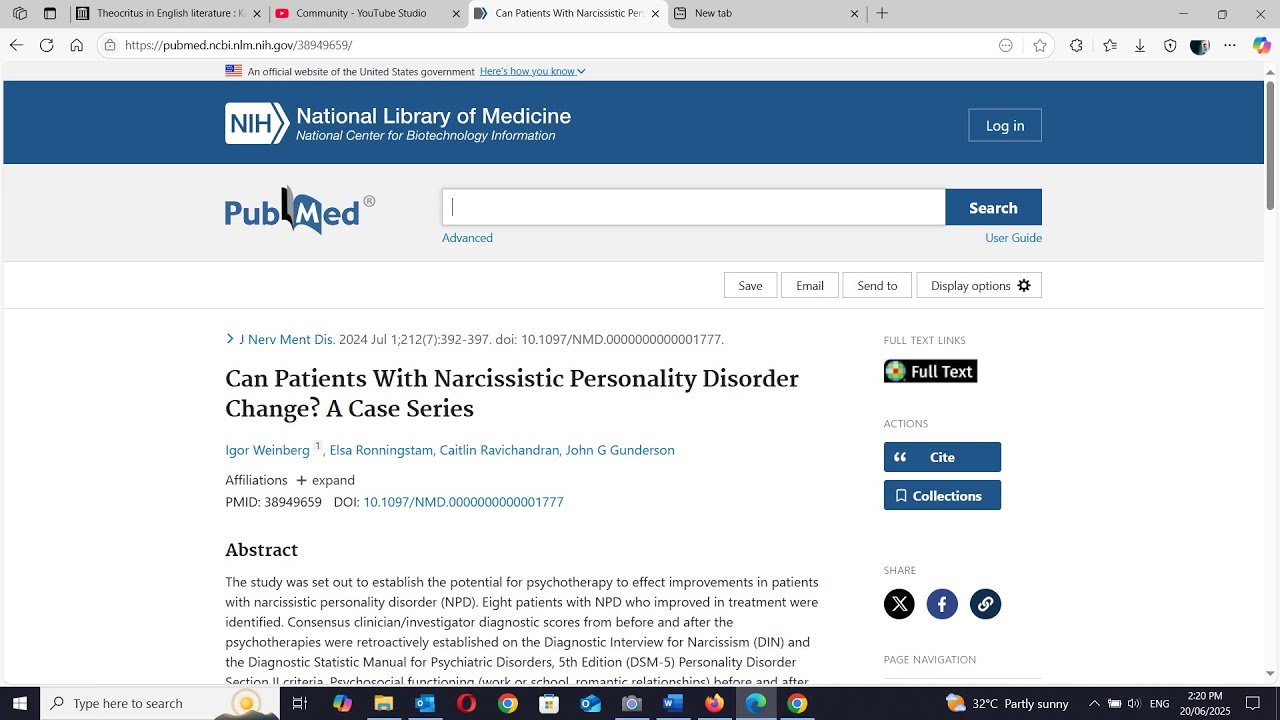
NEW STUDY: NPD Cured? NOT!
-
6

Anxiety: Root of OCD, Paranoia, Panic Attacks
-
7

Repentant Narcissist, Therapist Must Accept Diagnosis (12 Steps of Narcissists Anonymous)
-
8

Anxious Personality Pandemic and Its Therapy (Intl. Conf. Depression, Anxiety and Stress Management)